Long Live the Trainwreck: Why Gloriously Bad Entertainment Is the Best Thing on Your Screen Right Now
Let's paint a picture. It's Friday night. You could watch that critically acclaimed limited series everyone's been talking about — the one with the prestige cast and the devastating third act and the cinematography that belongs in a museum. You've had it queued for weeks. You open Netflix, hover over it for a solid thirty seconds.
And then you put on a reality show where strangers compete for a cash prize by doing something completely unhinged, or a B-movie where the CGI looks like it was rendered on a 2009 laptop, or a TikTok compilation of someone attempting increasingly chaotic DIY projects with absolutely no self-awareness. And it is, genuinely, the best decision you make all week.
Welcome to the cult of gloriously bad entertainment. Population: a lot more of us than anyone's admitting.
The Death of Ironic Distance
For a while, there was a comfortable shield we all hid behind. We watched bad content ironically. We were in on the joke. Enjoying something terrible was a performance of cultural sophistication — look at us, appreciating the absurdity, maintaining our taste while slumming it for a laugh.
That shield is gone. Or at least, it should be, because the gap between "watching ironically" and "genuinely enjoying this" has collapsed so completely that the distinction barely matters anymore. People are not hate-watching. They're love-watching. They're scheduling watch parties around movies with a 12% on Rotten Tomatoes. They're building communities around content that was never supposed to have communities.
The irony posture was always a little exhausting anyway. It required you to hold the thing at arm's length, to constantly signal that you knew better. Genuine enjoyment is so much more relaxing.
What Makes Something "Good Bad"
Not all bad entertainment is created equal, and the community of enthusiasts who've built their lives around this stuff will be the first to tell you there's a real craft to identifying the good stuff. The key ingredient is almost always sincerity.
The most beloved entries in the bad entertainment canon — The Room, Troll 2, early-era reality television at its most chaotic, certain corners of TikTok that defy all rational explanation — share a common quality: they were made by people who were trying. Genuinely, earnestly, completely trying, with whatever resources and talent they had available. The gap between ambition and execution is where the magic lives.
Contrast that with content that's intentionally campy or self-consciously terrible. Sharknado sequels, for instance, are trying to be bad, and there's something fundamentally less satisfying about that. The joy of bad entertainment is watching someone swing for the fences and miss spectacularly — not watching someone deliberately bunt into the dirt for laughs.
Authenticity, it turns out, is the defining quality of genuinely enjoyable bad content. Which is deeply ironic, given the context, but here we are.
The Exhaustion Factor
There's a real psychological reason that low-stakes, low-polish content has become such a comfort. We are living through what might be the most demanding era in the history of television storytelling. Peak TV gave us extraordinary art — and also gave us the expectation that every viewing experience should be emotionally rigorous, narratively complex, and thematically challenging.
That's a lot. Sometimes you've already done a lot. You've navigated a complicated day, processed complicated feelings, managed complicated relationships. The last thing you need is a show that's going to demand your full cognitive and emotional engagement for an hour.
Bad entertainment asks almost nothing of you. It doesn't require close attention to follow the plot, because the plot is either nonexistent or completely unhinged. It doesn't demand emotional investment, because the stakes are gloriously low. You can have it on while you fold laundry, text your friends, or simply exist without having to perform engagement. It's entertainment as ambient comfort.
The Community That Built Itself Around the Wreckage
One of the most fascinating things about the rise of intentionally-consumed bad content is the richness of the community it's generated. The people who love this stuff love this stuff — with a specificity and enthusiasm that rivals any prestige fandom.
There are subreddits dedicated to cataloging the best worst movies ever made. Discord servers where people watch terrible reality TV together and live-commentary it into something genuinely hilarious. TikTok accounts with millions of followers dedicated entirely to surfacing the most chaotic, inexplicable content the internet has to offer. The MST3K model — watching bad movies and riffing on them together — has been democratized and distributed across every platform imaginable.
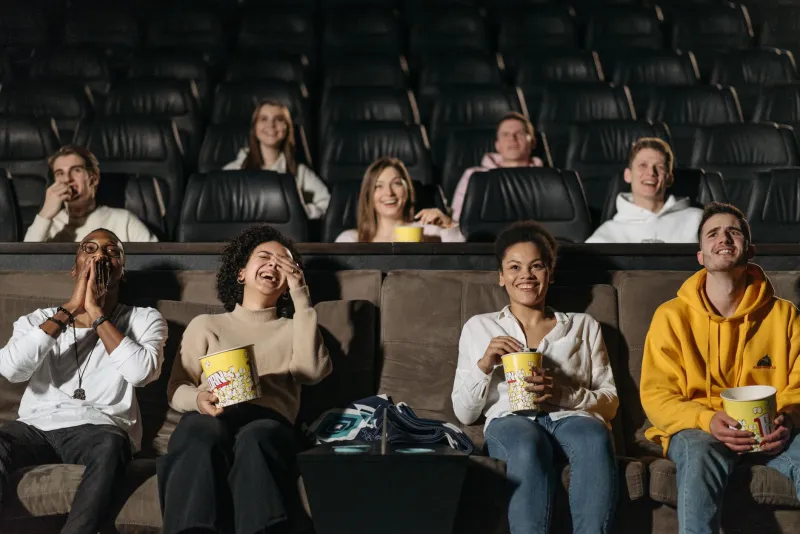
This community dimension is crucial. Bad entertainment is almost always better with other people. The shared experience of watching something go spectacularly off the rails together, of turning to someone and saying "are you seeing this" — that's a genuine bonding experience. Some of the best memories people have with friends involve huddled around a screen watching something absolutely terrible and losing their minds over it together.
What It Says About Where We Are
At a cultural moment defined by polish, optimization, and the relentless pursuit of perfection — filtered photos, algorithm-optimized content, prestige everything — there's something quietly radical about choosing the rough edges. Bad entertainment is, in its way, a rejection of the idea that everything needs to be good to be worth your time.
It's permission to enjoy things without justification. To find genuine happiness in something that wasn't supposed to make you happy. To laugh without the performance of sophistication.
There's a fashion parallel here, actually — the same cultural energy driving the return of "ugly" sneakers, intentionally distressed denim, and anti-aesthetic aesthetics in style is powering the love of bad entertainment. The rejection of seamlessness. The embrace of the flaw as feature. The understanding that sometimes the thing that's trying too hard to be perfect is far less interesting than the thing that's magnificently, gloriously, authentically itself — even if that self is a mess.
So go ahead. Put on the terrible movie. Watch the chaotic reality show. Let yourself enjoy it without the irony buffer. The trainwreck isn't beneath you. It might actually be exactly what you need.